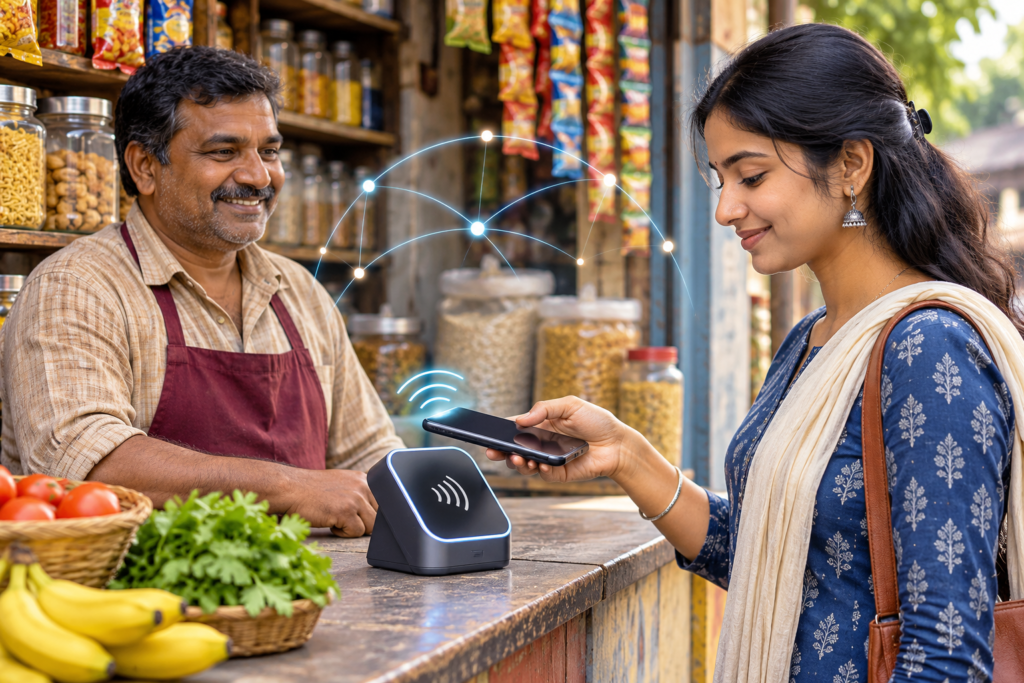
The National Payments Corporation of India has formed NPCI Tech Solutions Limited, a wholly owned subsidiary that will serve as the group’s technology and innovation arm. The announcement, reported on November 4, 2026, identifies artificial intelligence, blockchain, digital financial infrastructure and global capability centre services as areas of focus. For people who use UPI and businesses that accept it, the immediate news is the creation of a dedicated technology unit. Customer-facing changes would require separate announcements. Reuters report on NPCI Tech Solutions
What will NPCI Tech Solutions do?
A dedicated subsidiary gives the NPCI group an organizational home for technology development. Business Standard reported that NPCI appointed Vishal Kanvaty as managing director and chief executive. The areas named in the announcement describe a mandate. To understand how that mandate turns into work, look for a product name, identified participants, and a date when people outside the development team can try it. A pilot may cover a narrow group of institutions before any wider rollout. Business Standard’s announcement coverage
Digital financial infrastructure includes the systems and processes behind a payment. A customer sees a confirmation on a phone. A merchant also needs a transaction reference, a record that can be matched to the order, and a way to investigate exceptions. Banks and payment providers have their own operational requirements. A technology project that improves how these records line up could be valuable even if the checkout screen looks exactly the same.
Where AI could help a payments network
One possible use is grouping related events during an outage. If many merchants report delayed confirmations at once, an operations team could use a model to sort reports by provider, geography, or error pattern. Staff would still need to confirm the cause. A separate application might help fraud analysts prioritize transactions for review by combining several weak signals that would be tedious to examine individually. These are examples of how AI could be used, pending details of any NPCI project.
Payment networks handle legitimate surges, too. A busy festival evening might produce an unusual volume of transactions from merchants whose sales are normally quiet. An AI system that treats unusual activity as suspicious could send too many cases to reviewers or inconvenience customers. Evaluation should therefore track false alarms, how quickly staff can correct mistakes, and whether the system behaves consistently across different payment patterns. A useful trial would report those measures alongside any increase in detection.
When would blockchain be useful?
A shared ledger could be tested where several organizations need a consistent record of which steps have been completed and who recorded them. A hypothetical dispute workflow might record when a claim was opened, which participant supplied documentation, and when a case closed. Its usefulness would depend on whether the participants can agree on access and governance and whether a conventional shared database could do the same job more simply.
Blockchains raise practical questions about confidentiality, correcting errors and the handling of sensitive data. In a payment dispute, for example, the right to see a case status and the right to see underlying personal information can belong to different people. Any proposed implementation needs to explain how it makes that distinction. The subsidiary announcement does not establish a change to UPI settlement or show that a particular ledger design has been selected.
What UPI users and merchants can watch for
Consumers can treat a verified update from their bank or payments app as the source for any change to their own payment process. An unsolicited message asking someone to activate a new AI or blockchain feature through a link is a separate matter. If a notification looks unusual, opening the app directly is a practical way to see whether it appears in the usual account area.
Merchants have a more concrete way to judge a future rollout. Compare the rate of mismatched payment records, the time it takes to resolve a failed transaction, and the quality of reports available for bookkeeping. Keep a baseline from before the pilot and compare similar business days. A payment feature that saves work at closing time can be valuable even when customers hardly notice it. BuzzyBanana’s UPI reconciliation guide
Frequently asked questions
Does NPCI Tech Solutions run my UPI app?
The new subsidiary is a group technology and innovation arm. For a payment problem, start with the app or bank you used and retain the transaction reference for follow-up.
Did the announcement introduce new UPI fees?
The coverage of the formation announcement describes the subsidiary and its work areas. For fees that apply to a specific payment arrangement, check the terms supplied by your bank or provider and any applicable official circular.
What would count as a confirmed launch?
Look for a named product or feature, eligible participants, effective dates, and published instructions from the organization responsible for the rollout. Those details make it possible to distinguish an announced area of work from a change a customer or business can use.