
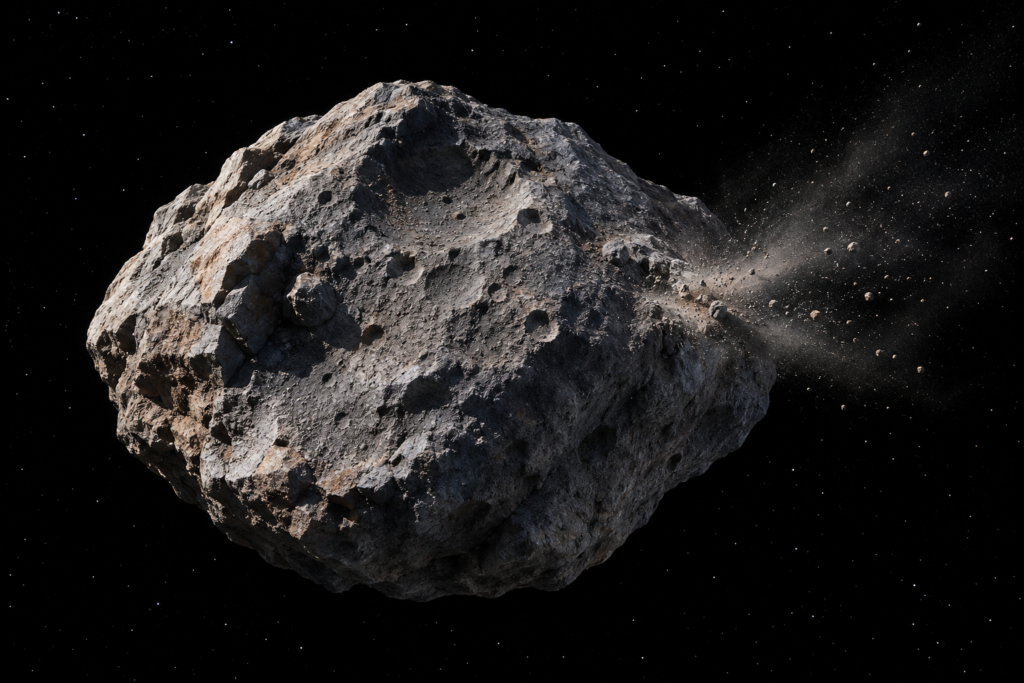
Sandia National Laboratories reported on November 3, 2026 that its researchers had accelerated a calculation used to model asteroid deflection. The team studied how an irregular asteroid might respond when X-rays heat its surface and material shoots away. The work makes it easier to examine how the same proposed intervention could produce different outcomes depending on where it is aimed. As of November 4, the result concerns a computational study of planetary defence. It does not identify an asteroid on a collision course with Earth. Sandia’s research announcement
What the faster asteroid deflection simulation does
The peer-reviewed study in Icarus examines how to compute the flow of vapor ejected from an asteroid’s surface during a pulse of energy. Heating can send material away from the surface, and the departing material carries momentum. The remaining body responds with a push in the opposite direction. Surface orientation matters because different areas face different directions, especially on a rocky object with protrusions and hollows. The Icarus study on vapor ejecta
A highly detailed simulation can be expensive to repeat many times. The team developed an approach that lets it examine different arrangements more quickly. Sandia reported a speedup of more than 1,600 times for its new algorithm in the context of the work. That comparison belongs to the modeled computation. The time required for a complete planetary-defence assessment would also depend on the available observations, the chosen intervention and any further calculations used to verify the result.
Why the shape of the asteroid changes the result
Imagine pushing a roughly spherical object through its centre. The push can change its motion with little tendency to spin it. If the effective force acts off centre, it can also change the object’s rotation. For a real asteroid, the direction and distribution of vapor leaving the surface help determine the equivalent of that push. A bulge or concavity can alter which surface areas contribute to it.
Sandia reported that, in one example, the change in rotational speed varied by a factor of 17 across different simulated conditions for an asteroid. This illustrates sensitivity within the study. It gives mission planners a reason to test plausible shapes and aiming choices instead of assuming that one representative case covers them all. The relevant outcome for a particular object would depend on the actual shape, spin and physical properties of that object.
How the research differs from NASA’s DART mission
NASA’s Double Asteroid Redirection Test used a spacecraft impact. In 2022, it struck Dimorphos, the moonlet of Didymos, and shortened the time Dimorphos took to orbit the larger asteroid by about 33 minutes. DART showed that researchers could measure an intentional orbital change in a test. Sandia’s study concerns an energy-driven surface response, evaluated computationally rather than through that spacecraft collision. NASA’s DART mission overview
The two examples involve momentum transfer, but the physics of delivering it differs. In DART, the spacecraft struck the target directly and the resulting ejecta contributed to the outcome. The Icarus study examines vapor driven away when energy is deposited at the surface. A model suited to one case needs separate evaluation before it can be used for another.
What planetary defence researchers still need to know
Early observations help determine an object’s orbit. A proposed intervention then requires more detail about the target, including its shape and rotation. Sandia pointed out that the simulation benefits from reasonably accurate shape data from all sides, which can be difficult to obtain quickly. Researchers can test several plausible shape models and record whether an aiming choice works across them. If the outcomes diverge, that result points to observations worth gathering before a decision.
Faster computation helps researchers explore uncertainty, and the value of the results still depends on the quality of the inputs. Ask whether a speed claim refers to a whole workflow or a particular calculation. Ask whether the team checked the faster results against more detailed models or measurements. These questions also apply when comparing research using the publication and impact indicators in BuzzyBanana’s guide to analytical and critical-thinking skills.
A useful simulation report should also explain which outputs it compares. A small change in the direction of the push may matter even if two models agree closely on its magnitude.
Frequently asked questions
Does faster modelling mean a deflection method is ready to deploy?
It means researchers can explore parts of the problem more efficiently. A decision about a mission would require observations of the target, mission design, independent checks and coordination.
Why can a small change in aim matter?
It can change which surfaces receive energy, where vapor escapes and how much of the resulting push goes into changing motion or spin.
Did DART change an asteroid’s path around the Sun by 33 minutes?
The widely cited result refers to the orbital period of Dimorphos around Didymos. It is a measurement of the two-asteroid system.