
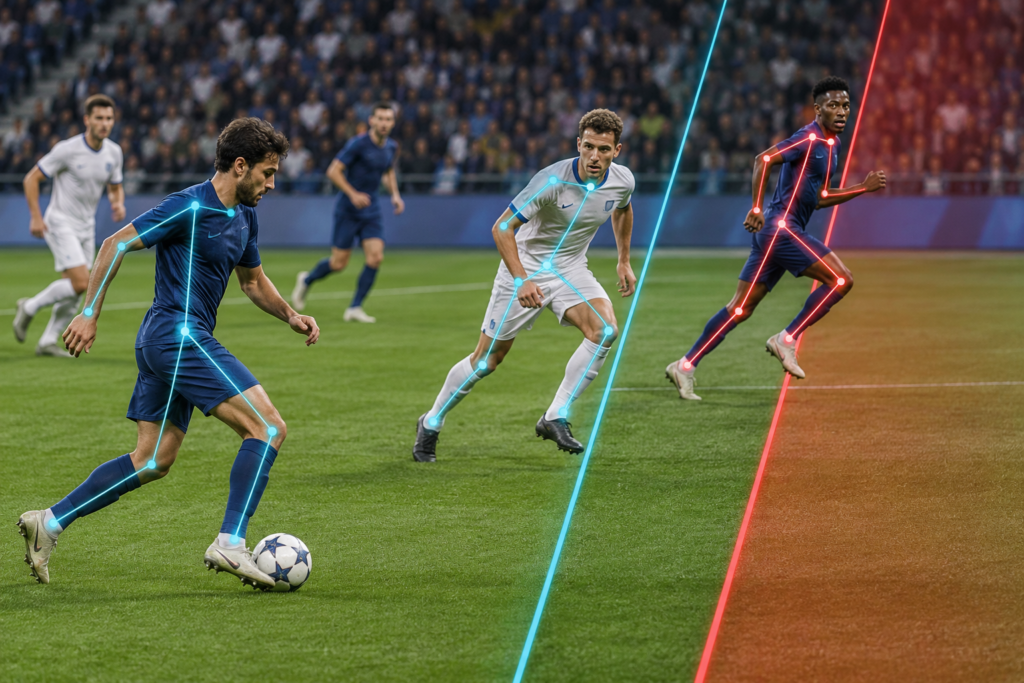
AI in sports is easiest to understand by looking at a specific decision. A video analyst may want to find every time a team lost possession under pressure. A match official may want to identify where players were when a pass was made. A broadcaster may need to locate key moments for a highlights package. Each job begins with data from a game and ends with someone interpreting or acting on it. FIFA’s advanced offside system at the 2026 World Cup shows what one well-defined use of that approach looks like. FIFA’s semi-automated offside technology overview
How the 2026 World Cup used tracking for offside
FIFA’s description of advanced semi-automated offside technology identifies several inputs: player and ball tracking, sensor data from the ball, pitch calibration, and three-dimensional player scans. These help establish where the relevant parts of a player’s body were when the ball was played. FIFA said its 2026 design could send alerts for clear offsides directly to on-field officials. The rule still depends on the circumstances of the play, and officials use their judgment in applying it. FIFA’s 2026 World Cup technology briefing
This is a useful example because the system has a specific job. Its performance can be examined in terms of the accuracy of the tracking, how often a sequence needs additional review, and how quickly an official receives usable information. A club assessing a different tool can ask equally concrete questions about the decision it is intended to support.
How teams can use AI to review game film
A team may use tracking or video analysis to index clips by the actions a coach wants to review. For example, an analyst could retrieve sequences in which a defender stepped forward as an opponent received the ball. The coach can then watch the clips and ask what happened to the space behind the defender. A retrieval tool saves time if it finds the right sequences consistently, including examples that would be easy to miss in a manual search.
To test that, a team can ask an analyst to label a sample of games independently. Compare the clips the software found with the human review. If the software works well at home and misses sequences in away footage, investigate the camera angle or recording quality before expanding its use. Include the time an analyst spends checking and correcting results when calculating the time saved.
Where workload and injury estimates need human review
Tracking data can summarize distance, speed and repeated efforts. These measurements may help staff review changes in an athlete’s training, alongside the athlete’s feedback and other information. A short game with intense repeated efforts can be different from a long session at a steady pace, even when the overall distance is similar. Define the measure before comparing sessions and look at the role and training history of the individual athlete.
An estimate that flags a change is a prompt for professional review. A model developed on one group may behave differently with younger athletes, different positions, or another level of competition. Teams can set a clear rule for who sees individual information, which decisions require additional review, and how an athlete can correct an erroneous record. Keep medical and performance data available only to staff who have a defined reason to see it.
How AI changes what fans see
Deloitte’s 2026 sports outlook discusses potential AI applications in game-film analysis, ticketing and content creation. A broadcaster can use automation to locate clips, prepare metadata or help produce captions. Editors can check names, times and competition details before publication. For highlights, a good review also asks whether a short clip gives enough context to understand a decision or turning point. Deloitte’s 2026 sports industry outlook
When following a competition, it helps to distinguish the replay, the tracking graphic and the official result. Each presents a different part of what happened. For upcoming events where these tools may appear in coverage, see BuzzyBanana’s November sports calendar.
There is also value in measuring disagreement. When two analysts label the same play differently, document their reasons and agree on a clearer definition. A consistent review standard makes it easier to tell when the tool is genuinely improving.
Frequently asked questions
Does AI decide offside on its own?
FIFA describes the system as semi-automated. Tracking and alerts help officials assess a play, and the officials apply the rules.
Can a team use AI without collecting new data?
Yes. A team can start by tagging existing video or making past clips easier to find. The usefulness depends on the quality of its footage and the task it wants to improve.
How can a team tell whether a sports AI tool is worthwhile?
Pick a real workflow and measure the time saved, errors and manual corrections on representative games. Give the users who review the output a way to report recurring problems.